

AndaSeat Phantom 4 Wins Gold as 2026 Tokyo Design Awards Recognizes the Evolution of Responsive Seating
Phantom 4 tokyo award
Phantom 4
Phantom 4
AndaSeat Phantom 4 Wins Gold as 2026 Tokyo Design Awards Recognizes the Evolution of Responsive Seating
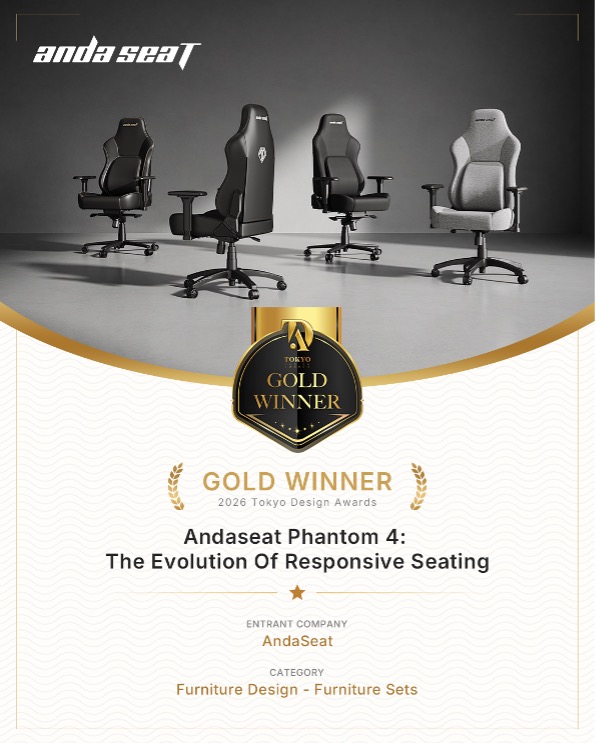
SPOKANE, WA, UNITED STATES, October 3, 2026 /EINPresswire.com/ -- AndaSeat has received a Gold award at the 2026 Tokyo Design Awards for “Andaseat Phantom 4: The Evolution of Responsive Seating,” recognized in the Furniture Design – Furniture Sets category. The official Tokyo Design Awards winner listing identifies AndaSeat as the entrant and Phantom 4 as the recognized project, while the awards’ official communication highlights Dynamic Auto-Tracking Lumbar Support as a central element of the design.The recognition arrives as ergonomics research increasingly moves beyond evaluating one static sitting position and toward understanding how people change posture over time. A 2026 scoping review of prolonged sitting in office environments examined 42 studies and found growing use of pressure sensors, inertial sensors and computer-vision systems to observe sitting behavior continuously rather than relying only on single-point assessments. A separate 2026 review covering 197 studies and 282 sensing technologies similarly reflected growing interest in identifying sedentary behavior and developing more responsive approaches to prolonged sitting.
Those studies do not evaluate Phantom 4 and do not establish that movement itself is automatically beneficial. They do, however, reflect a broader change in the questions being asked around seating: rather than assuming that one ideal posture can be established and maintained, designers and researchers are increasingly considering how support should respond as real users shift, lean, recline and move through different activities. That question sits at the center of Phantom 4’s design philosophy.
From Fixed Support to Responsive Contact
Traditional ergonomic seating often begins with a fixed-support model. The user adjusts the chair, settles into a preferred position and relies on the backrest and lumbar system to remain where they were set. Phantom 4 introduces a different relationship between the user and the lumbar structure by separating deliberate adjustment from responsive movement.
The Dynamic Auto-Tracking Lumbar system allows the user to choose one of 15 depth positions across a 0–95 mm range, establishing how prominent the lower-back support should feel. Once that preference has been selected, the lumbar structure can swivel approximately 5 degrees to either side and tilt through a 25-degree forward-and-back range as the user changes position against the backrest. The result is a two-stage interaction: the user determines the primary support level, while the mechanism accommodates smaller positional changes without requiring the entire lumbar setting to be manually rebuilt.
That distinction is important because responsive seating is not the same as unrestricted motion. A 2024 Applied Ergonomics study comparing traditional and dynamic sitting found that dynamic seating produced greater pelvis and lumbar movement during activity-guided tasks, while lumbar movement during ordinary computer work was more similar between the two conditions. The study did not find a simple universal benefit from movement alone, reinforcing the idea that useful motion depends on the task and the context in which it occurs.
A Stable Seat Creates the Reference Point
Responsive design also requires deciding which parts of the chair should remain stable. Phantom 4 uses a molded 55 kg/m³ cold-cure foam seat as the relatively consistent foundation beneath the moving lumbar mechanism. While the back-support structure can follow smaller shifts in the torso, the seat continues to provide a defined surface for the pelvis and thighs.
This relationship creates a clearer mechanical hierarchy within the chair. The lower seating platform acts as a reference layer, while the lumbar region introduces controlled movement above it. Phantom 4 therefore does not attempt to make every contact point mobile at the same time. Instead, the design combines a stable seated base with a more responsive back-support structure so the user retains a predictable anchor while changing position.
The same principle applies to the chair’s broader movement. Phantom 4 provides up to 135 degrees of backrest recline and approximately 15 degrees of rocking, but these larger changes remain deliberately controlled by the user. The auto-tracking lumbar responds within the seated position, while recline and rocking allow the user to intentionally change the overall torso relationship to the chair.
Phantom 4 and Phantom 4 Pro Offer Different Levels of User Control
The distinction between automatic response and deliberate adjustment also shapes the relationship between Phantom 4 and Phantom 4 Pro. Both models share the same central Dynamic Auto-Tracking Lumbar architecture, including the 15-level depth adjustment and four-way responsive movement, but they provide different levels of manual control around that core.
The standard Phantom 4 uses 2D armrests with vertical and forward-and-back adjustment, an elastic-strap memory-foam head pillow and a butterfly tilt mechanism. It also provides a 10 cm seat-height adjustment range. Phantom 4 Pro expands the amount of peripheral control through 3D 360-degree rotating armrests with approximately 6 cm of forward-and-back movement and 7 cm of vertical adjustment, along with a magnetic memory-foam head pillow featuring a cooling layer and around 20 cm of vertical positioning range. The Pro model also adds tilt locking through its multi-function tilt mechanism. (andaseat.com)
This two-model strategy reflects a difference in control density rather than a simple assumption that more controls are automatically better. Phantom 4 provides the responsive-lumbar concept with a more straightforward group of secondary adjustments, while Phantom 4 Pro gives users who want greater manual refinement additional control over arm, head and tilt positioning. Both models retain the same underlying principle: the chair should automate only the movements that can reasonably respond to the body while preserving deliberate user choice where preference matters most.
Responsive Design Does Not Mean Maximum Automation
The broader design significance of Phantom 4 lies in this selective approach to responsiveness. Recent ergonomics research is increasingly using sensors, computer vision and AI-assisted analysis to understand posture over time, but newer reviews also caution that technological sophistication by itself does not guarantee useful or practical outcomes.
A 2026 critical scoping review of office ergonomics examined 77 studies and found rapid growth in sensor-based and AI-enabled posture analysis. At the same time, the authors emphasized the importance of usability, validation, trust and broader human factors when such technologies move beyond controlled environments.
Phantom 4 takes a mechanical rather than algorithmic approach to the same broader question. It does not score posture, issue behavioral judgments or attempt to predict every movement. Instead, the user chooses lumbar depth, recline state, seat height and arm position, while the lumbar mechanism accommodates smaller shifts that occur after those choices have been made. The chair therefore introduces responsiveness without turning the act of sitting into another system that constantly requires attention.
Usability Extends Beyond Sitting
The Phantom 4 Series also applies its interaction philosophy beyond the moment when the user is seated. Magnetic side covers around the backrest connection area are designed to snap into position and make the assembly and maintenance process more straightforward. Rather than treating installation as separate from product usability, AndaSeat has incorporated access and simplification into the physical construction.
This approach reflects a broader understanding of how furniture is experienced. A chair is not only used while someone is sitting in it; the ownership experience also includes unpacking, assembly, adjustment, cleaning and occasional maintenance. Features that reduce unnecessary steps in those processes support the same design goal as the dynamic lumbar system: lowering the amount of attention the product demands from the user.
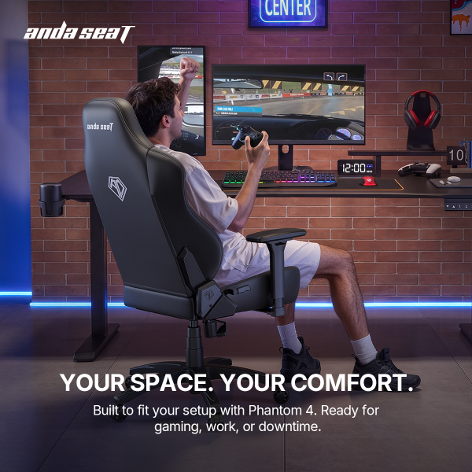
That principle is particularly relevant to a chair positioned for work, gaming and general home use, where the product may move through different rooms, setups and ownership conditions over time. Responsive design, in this sense, involves not only how the chair reacts to body movement but also how easily the product can be configured and maintained.
Tokyo Design Awards Recognition Reflects a Broader Seating Direction
The Tokyo Design Awards lists “Andaseat Phantom 4: The Evolution of Responsive Seating” in the Furniture Design – Furniture Sets category, with AndaSeat named as the entrant. The official recognition places Phantom 4 within a design discussion that extends beyond a single adjustment mechanism and toward a more integrated understanding of how stability, manual control and responsive movement can work together.
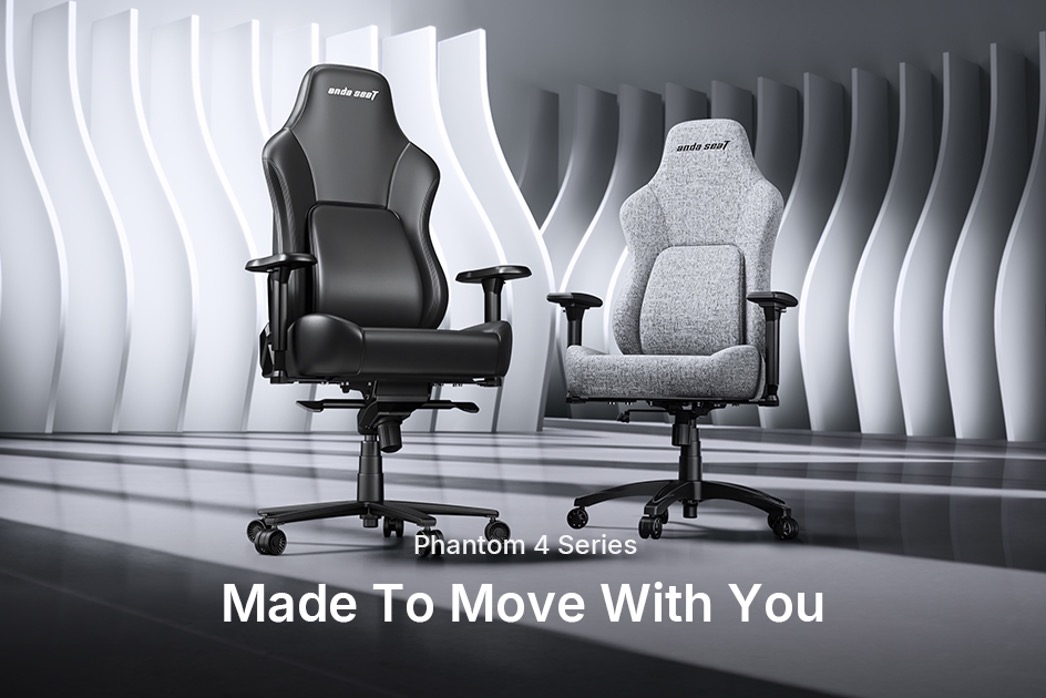
For AndaSeat, “Made To Move With You” is therefore not intended to mean that every part of the chair should continuously move. The seat remains comparatively stable. Larger recline decisions remain user-controlled. Lumbar depth remains a deliberate preference. The auto-tracking structure responds within that framework, creating movement only where the design is intended to preserve back contact during smaller shifts.
That distinction defines the broader concept behind The Evolution of Responsive Seating. The next stage of ergonomic seating does not necessarily depend on fixing the body into one idealized position or automating every interaction. It can instead involve a more deliberate division of responsibilities between the user and the chair: the user defines the desired support state, while selected mechanical structures respond as real movement occurs within it.
About AndaSeat
Founded in 2007, AndaSeat develops ergonomic seating and workspace products for gaming, professional and home environments. Its portfolio includes ergonomic chairs, standing desks, monitor arms and related workspace accessories. AndaSeat’s product-development approach combines structural engineering, material design, adjustable ergonomics and human-centered interaction, with an emphasis on how furniture responds to changing bodies, tasks and environments.
Caroline Chen
AndaSeat
+ + 86 139 2232 2347
email us here
Visit us on social media:
LinkedIn
Instagram
Facebook
YouTube
TikTok
X
Legal Disclaimer:
EIN Presswire provides this news content "as is" without warranty of any kind. We do not accept any responsibility or liability for the accuracy, content, images, videos, licenses, completeness, legality, or reliability of the information contained in this article. If you have any complaints or copyright issues related to this article, kindly contact the author above.
