

360 Degree Camera Market Growth Forecast 2026–2035: USD 10.96 Billion at 16.2% CAGR
360 Degree Camera Market
360 Degree Camera Market Size, Share and Research Report By Component (Hardware and Software), By Connectivity Type (Wired and Wireless)
The 360 Degree Camera Market is expanding with increasing demand for immersive imaging, virtual reality content, and advanced surveillance applications.”
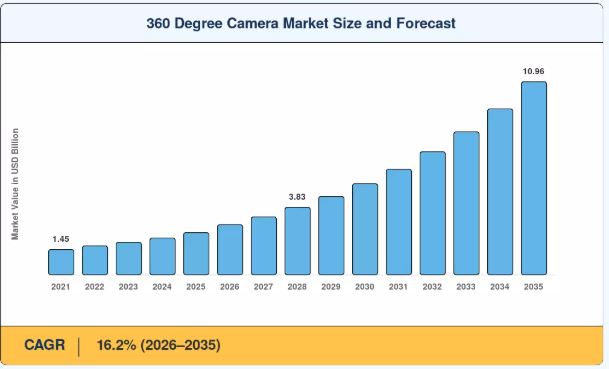
BERLIN, BERLIN, GERMANY, June 29, 2026 /EINPresswire.com/ -- The Global 360 degree camera market reached an estimated USD 2.41 Billion in 2025 and is projected to grow from USD 2.84 Billion in 2026 to USD 10.96 Billion by 2035, registering a CAGR of 16.2% during the forecast period. — Market Research Future (MRFR)
Two major catalysts are driving this explosive trajectory: the accelerating integration of 360-degree imaging into immersive media, virtual reality (VR), and augmented reality (AR) content ecosystems where demand for omnidirectional capture has surged alongside the proliferation of Meta Quest, Apple Vision Pro, and enterprise XR headsets and the rapid adoption of 360-degree camera systems in professional surveillance, autonomous vehicle perception stacks, and real estate virtual tour platforms. With global 360-degree camera shipments surpassing 8 million units annually by 2024, the technology is completing a transition from niche action-sports accessory to mission-critical imaging infrastructure across consumer, commercial, and industrial sectors.
Legacy single-lens camera systems and multi-camera rig assemblies are giving way to compact, AI-enhanced 360-degree imaging platforms that deliver real-time stitching, stabilization, spatial audio capture, and cloud-connected live-streaming within form factors small enough to mount on helmets, drones, vehicles, and robotic platforms.
A recent analysis by IDC estimated that enterprise deployments of 360-degree camera systems for remote inspection, construction site monitoring, and insurance claims documentation grew by over 47% between 2022 and 2024 a trajectory that underscores the technology’s expanding role beyond consumer content creation into high-value professional and industrial applications.
Get Full PDF Sample Copy of Report: (Including Full TOC, List of Tables & Figures, Chart) @
https://www.marketresearchfuture.com/sample_request/3688
➤ How Significant Is the 360 Degree Camera Market’s Growth?
The 360 degree camera market has demonstrated exceptional and sustained expansion, rising from approximately USD 718.4 million in 2021 to an estimated USD 2.41 Billion in 2025, reflecting a robust historical growth trajectory underpinned by falling sensor costs, maturing stitching algorithms, and rapidly expanding end-market demand across consumer, media, security, and automotive sectors. The market is projected to nearly quadruple over the next decade, driven by the convergence of 360-degree imaging with spatial computing platforms, the explosive growth of virtual tour and remote inspection workflows, and increasing deployment in autonomous vehicle perception and public safety surveillance infrastructure.
Rising demand for immersive digital experiences in media, entertainment, education, and real estate has created structural tailwinds for the 360-degree camera market well beyond its origins in action sports and adventure content creation. Real estate agencies deploying virtual tour technology reported 40–49% reductions in time-to-sale for listings featuring 360-degree walkthroughs. Insurance carriers adopting 360-degree claims documentation platforms achieved 30–35% reductions in on-site adjuster visits. These measurable ROI outcomes are accelerating enterprise adoption and expanding the addressable market well beyond the consumer imaging segment that defined the technology’s early growth phase.
➤ What Does the Future Hold for the 360 Degree Camera Market?
Artificial intelligence and spatial computing stand at the forefront of the market’s next growth phase. AI-powered 360-degree camera platforms are moving beyond passive omnidirectional capture toward active scene understanding integrating real-time object detection, semantic segmentation, depth estimation, and behavioral analytics directly within the camera’s onboard processing pipeline. These capabilities are enabling applications that were previously impossible with conventional imaging systems, including autonomous navigation for delivery robots and inspection drones, AI-driven crowd density monitoring in public venues, and real-time hazard detection on construction sites and industrial plant floors.
The emergence of spatial computing as a mainstream platform anchored by Apple Vision Pro, Meta Quest 3, and a growing ecosystem of enterprise AR headsets is creating structural demand for high-quality 360-degree content capture infrastructure. As spatial video and immersive media become standard content formats for social platforms, enterprise collaboration tools, and entertainment ecosystems, the 360-degree camera market is positioned as foundational capture infrastructure for the spatial computing era. Major platforms including YouTube, Meta, and emerging spatial media networks are actively investing in 360-degree content ecosystems that incentivize creator adoption of omnidirectional capture hardware.
Autonomous vehicle development represents another high-growth vector for 360-degree camera technology. Surround-view camera systems providing seamless 360-degree environmental perception are becoming standard equipment in advanced driver assistance systems (ADAS) across passenger vehicles, commercial trucks, and autonomous last-mile delivery platforms. The shift from discrete multi-camera setups to integrated 360-degree perception modules with unified AI processing is reducing vehicle integration complexity, cutting system costs, and improving the reliability of environmental awareness in complex urban driving scenarios.
➤ Who Are the Key Players in the 360 Degree Camera Market?
The 360 degree camera landscape is characterized by a dynamic mix of consumer electronics giants, specialized imaging technology developers, and enterprise-focused visual intelligence platform providers. Key participants shaping the competitive dynamics include:
★Insta360 (Arashi Vision Inc.) — the global market leader in consumer and professional 360-degree cameras, with the ONE X, ONE RS, and Titan series setting benchmarks for image quality, AI stabilization, and creator-oriented feature design
★GoPro, Inc. — extending its action camera dominance into 360-degree imaging through the MAX series, with deep integration into its cloud subscription and content creation ecosystem
★Ricoh Company, Ltd. — a pioneer in consumer 360-degree cameras with the THETA series, maintaining strong positions in real estate virtual tours and enterprise documentation workflows
★Samsung Electronics — delivering the Gear 360 platform and advancing 360-degree imaging integration within its broader mobile and XR device ecosystem
★Garmin Ltd. — providing VIRB 360 action camera systems with GPS integration and rugged design optimized for outdoor sports and adventure applications
★Kandao Technology — a leading developer of professional-grade 360-degree and VR camera systems, including the Obsidian series widely used in cinematic VR production
★Matterport, Inc. — delivering 3D spatial data capture platforms combining 360-degree imaging with LiDAR scanning for real estate, construction, and facilities management digital twin applications
★Axis Communications — providing enterprise-grade 360-degree network cameras for physical security, perimeter surveillance, and smart building applications
★Hanwha Vision (formerly Hanwha Techwin) — offering a comprehensive range of 360-degree fisheye and panoramic security cameras for commercial, government, and critical infrastructure surveillance
★360fly (Sensor Industries) — developing single-lens 360-degree cameras optimized for extreme sports, law enforcement body camera applications, and first-responder documentation
Competition in the market is intensifying as vendors race to embed AI-powered stitching, real-time streaming at 8K resolution, and spatial audio capture into increasingly compact and affordable platforms. Strategic partnerships with VR content platforms, real estate technology providers, automotive OEMs, and public safety agencies are reshaping vendor positioning and accelerating adoption across the market’s highest-growth application segments.
➤ What Are the Emerging Trends in the 360 Degree Camera Market?
Several transformational trends are redefining how the 360 degree camera market evolves through 2035:
AI-Powered Real-Time Stitching & Stabilization: On-device AI processors are eliminating the latency and quality limitations of traditional multi-lens stitching pipelines, enabling seamless 360-degree video at 8K resolution with sub-100ms processing latency unlocking live-streaming applications in sports broadcasting, remote inspection, and emergency response.
Spatial Computing Content Ecosystems: The launch of Apple Vision Pro and the maturation of Meta Quest have created structural demand for spatial video and 360-degree immersive content, driving a new wave of creator-focused 360-degree camera development and platform integration from manufacturers targeting the spatial computing content supply chain.
Autonomous Vehicle Surround Perception: Integration of 360-degree camera systems into ADAS and autonomous driving stacks is accelerating, with automotive OEMs standardizing surround-view camera modules across passenger vehicle, commercial truck, and autonomous last-mile delivery platforms to enable comprehensive environmental awareness at lower cost than LiDAR-only architectures.
Digital Twin & 3D Spatial Data Capture: 360-degree cameras combined with photogrammetry software and LiDAR sensors are becoming the primary capture infrastructure for building digital twins across construction, real estate, infrastructure management, and heritage preservation applications with platforms like Matterport, NavVis, and Leica BLK enabling automated, walkthrough-based 3D model generation.
Enterprise Remote Inspection & Documentation: Insurance carriers, utility operators, industrial facilities, and public infrastructure managers are deploying 360-degree camera platforms to enable remote visual inspection, reducing the cost, risk, and time associated with on-site survey visits while producing richer, more defensible visual documentation records.
Live Event & Immersive Broadcasting: Sports rights holders, concert promoters, and live event broadcasters are deploying 360-degree camera arrays to produce immersive multi-angle content for VR headsets and mobile platforms, creating new premium content tiers and audience engagement formats that command higher monetization rates than traditional linear broadcasts.
Get access to the full description of the report @
https://www.marketresearchfuture.com/reports/360-degree-camera-market-3688
➤ How Is the 360 Degree Camera Market Segmented?
The 360 degree camera market report provides a comprehensive segmentation framework:
By Resolution: Below 4K, 4K, 8K & Above
By Application: Media & Entertainment, Virtual Tours & Real Estate, Automotive & ADAS, Security & Surveillance, Sports & Adventure, Industrial Inspection & Remote Operations
By Connectivity: Wired, Wireless (Wi-Fi/Bluetooth), Cellular (4G/5G-Enabled)
By End User: Consumer, Commercial & Enterprise, Government & Defense, Automotive OEMs
By Organization Size: Individual Creators & SMEs, Large Enterprises & System Integrators
➤ What Are the Regional Insights from the 360 Degree Camera Market?
North America commands approximately 35% of global 360 degree camera market share, underpinned by the world’s largest consumer electronics market, high adoption of VR and spatial computing platforms, and strong enterprise demand for 360-degree documentation and remote inspection workflows across insurance, construction, and industrial sectors. The United States is home to leading 360-degree platform developers and a highly active VR content creator ecosystem, with strong investment flows from venture capital and major technology companies into spatial computing infrastructure that directly stimulates 360-degree camera demand.
Europe holds the second-largest share at approximately 27%, with Germany, the United Kingdom, France, and the Netherlands representing the primary markets. European adoption is driven by strong enterprise use cases in construction digital twin workflows, heritage site preservation, automotive OEM ADAS development programs, and a growing smart city surveillance infrastructure investment. The EU’s Horizon Europe research program is actively funding spatial data capture and XR application development, creating additional institutional demand for 360-degree camera technology across academic and public sector organizations.
Asia-Pacific represents the fastest-growing region, projected to register a CAGR of approximately 15.8% through 2035, driven by China’s dominant consumer electronics manufacturing ecosystem, Japan’s and South Korea’s leadership in automotive camera sensor development, and rapidly expanding VR content and gaming markets across the region. Chinese manufacturers including Insta360 and Kandao have emerged as global leaders in 360-degree camera hardware, combining competitive pricing with rapid product innovation cycles that are expanding global market accessibility and accelerating consumer adoption across both developed and emerging markets.
The Middle East & Africa region is projected to register above-average growth through 2035, driven by smart city infrastructure investment across Gulf Cooperation Council (GCC) states — where 360-degree camera systems are being deployed for public safety surveillance, traffic management, and tourism destination virtual tour development. Saudi Arabia’s Vision 2030 and the UAE’s Smart Dubai initiatives are generating significant institutional demand for advanced imaging and spatial data capture infrastructure across government, hospitality, and cultural sectors.
Latin America rounds out the global picture, with Brazil, Mexico, and Colombia representing the most active markets. Growing adoption of 360-degree virtual tour technology in the Brazilian and Mexican real estate sectors, combined with expanding media production and live event broadcasting industries across the region, is creating incremental demand for professional-grade 360-degree camera systems. Regional security concerns are also driving investment in 360-degree surveillance camera infrastructure across commercial retail, transportation hubs, and critical infrastructure sites.
➤ FAQs :
Q - What minimum frame rate should procurement teams specify for automotive 360° cameras?
Most Tier-1 automotive suppliers require at least 30 fps at 4K resolution for ADAS surround-view compliance. Some OEM platforms targeting Level 3+ autonomy are specifying 60 fps to support real-time neural-network inference
Q - How does sensor size influence low-light performance in professional 360° rigs?
Larger 1/1.7-inch sensors capture roughly 2.5× more light than 1/2.3-inch alternatives, significantly reducing noise in interior and nighttime 360° shoots. Professional rigs priced above USD 3,000 typically use the larger sensor format
➤➤➤ Industry Analysis Reports by Market Research Future:
Underfill Dispensers Market-
https://www.marketresearchfuture.com/reports/underfill-dispensers-market-12600
Micro Inverter Market-
https://www.marketresearchfuture.com/reports/micro-inverter-market-12609
Etch Equipment Market-
https://www.marketresearchfuture.com/reports/etch-equipment-market-13902
Integrated Circuit Chip Market-
https://www.marketresearchfuture.com/reports/integrated-circuit-chip-market-13910
Semiconductor Inspection Microscope Market-
https://www.marketresearchfuture.com/reports/semiconductor-inspection-microscope-market-14030
Rack Mount Servers Market-
https://www.marketresearchfuture.com/reports/rack-mount-servers-market-16114
Property Insurance Market-
https://www.marketresearchfuture.com/reports/property-insurance-market-16204
Thyristor Market-
https://www.marketresearchfuture.com/reports/thyristor-market-17183
Thermal Systems Market-
https://www.marketresearchfuture.com/reports/thermal-systems-market-17190
Precision Parts For Equipment Market-
https://www.marketresearchfuture.com/reports/precision-parts-for-equipment-market-17762
Sagar Kadam
Market Research Future
+ + +1 628-258-0071
email us here
Visit us on social media:
LinkedIn
Facebook
YouTube
X
Legal Disclaimer:
EIN Presswire provides this news content "as is" without warranty of any kind. We do not accept any responsibility or liability for the accuracy, content, images, videos, licenses, completeness, legality, or reliability of the information contained in this article. If you have any complaints or copyright issues related to this article, kindly contact the author above.
