

Sleeper Sofa mechanisms with rigid support bar systems are now moving to a distributed-load design
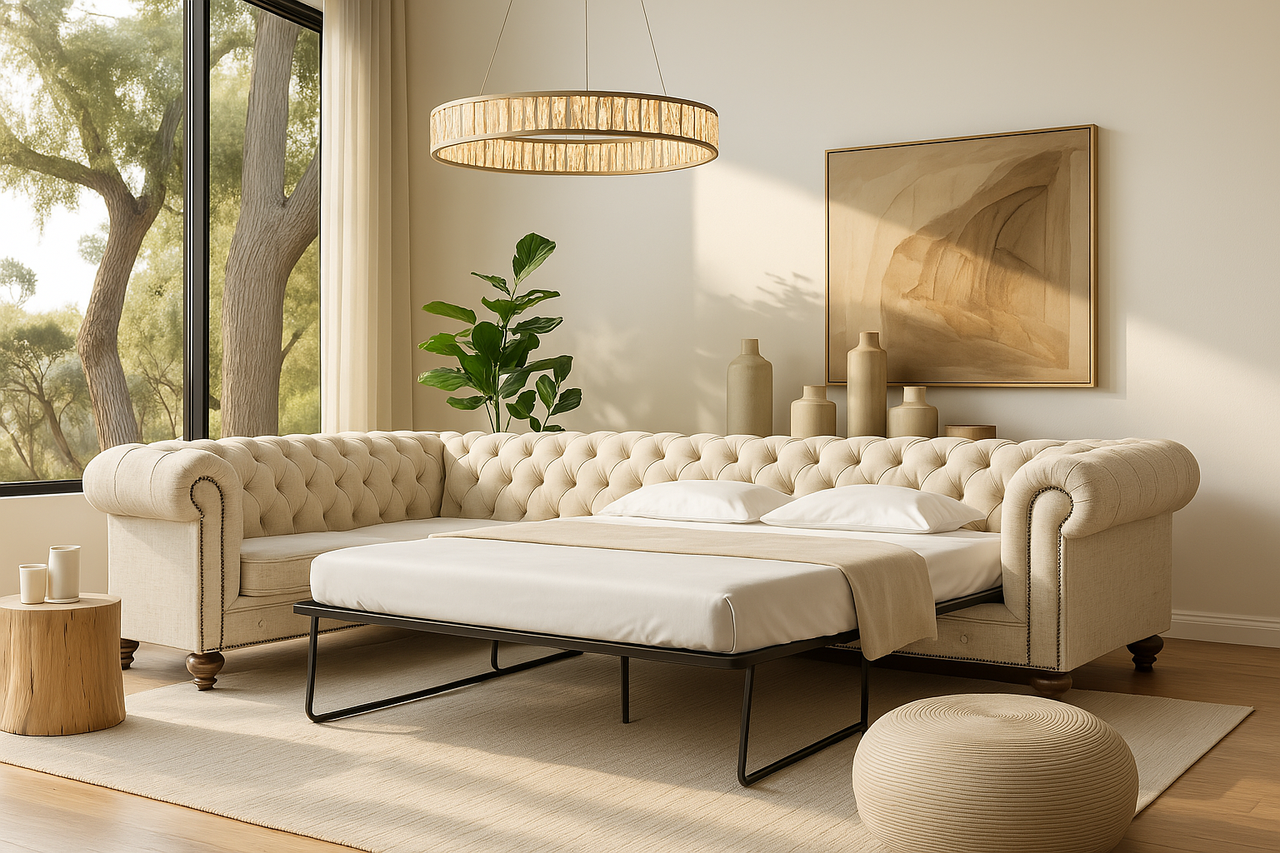
Custom Sofa by Dreamsofa
Anyone who has spent a night on a traditional sleeper sofa knows the problem: a metal support bar pressing through the thin mattress directly beneath the lower back. The sensation creates immediate discomfort, discourages guest usage, and often leaves sleepers stiff the following morning.
The issue is structural and widespread across the industry. In most convertible sofas, the fold-out frame mechanism places a rigid support bar directly beneath where the sleeper lands, creating a pressure point that disrupts spinal alignment. That bar — typically 2–3 inches wide and running the length of the mattress — becomes the focal point of discomfort throughout the night.
The design represents an engineering trade-off: traditional sleeper mechanisms prioritize compactness when folded over comfort when extended. The market impact is measurable. Many guests avoid sleeper sofas entirely, choosing instead to sleep sitting upright on regular seating or on the floor — neither of which supports restful sleep.
For homeowners, the limitation means a guest room function that doesn't work. For Airbnb and vacation rental hosts, it translates to lower guest satisfaction scores and online reviews. The sleeper sofa market has remained largely underserved, with most manufacturers treating sleepers as an afterthought — a checkbox feature added to a standard sofa design rather than a core engineering challenge.
DreamSofa's DreamSleeper™ engineering reworks the mechanism from the foundation. Instead of a single frame bar running beneath the mattress surface, the support structure distributes load across a wider base, maintaining an even sleeping surface from edge to edge. The company's sleeper sofa lineup uses kiln-dried solid wood framing paired with 8-gauge sinuous-spring suspension and 2.5lb high-density foam, allowing the piece to perform as both a daily sofa and guest bed without the sag typical of convertible designs.
The structural change has practical implications for spinal health. The Mayo Clinic emphasizes that maintaining comfortable spinal alignment during rest — particularly in the lumbar region — is important for sleep quality. A flat, continuous sleeping surface supports proper alignment; when the spine encounters a rigid bar mid-mattress, it forces compensatory micro-adjustments throughout the night, interrupting deep sleep cycles.
Durability also improves with the distributed-load design. Traditional sleeper mechanisms wear faster because hinges and the support bar absorb all mechanical stress. DreamSleeper™'s approach spreads wear evenly, extending the mechanism's functional lifespan. The company's modular design allows for FlexForm Sizing™, enabling custom dimensions to fit tight entryways or unusual room layouts — a practical feature in apartments where standard sleeper sofas cannot pass through doorways.
Operational ease addresses another overlooked aspect. Traditional sleeper mechanisms are often stiff and difficult to open or close, sometimes requiring two people to operate safely. Over time, hinges wear further, compounding the friction. DreamSofa engineered its mechanism for smooth, single-person operation — the mechanics should be as intuitive to use as the sofa is to sit on.
"The bar you feel in the middle of the night is an engineering problem, not something owners should have to live with," said Milan Emadi, CEO of DreamSofa. "We designed DreamSleeper™ so the surface you sit on by day and sleep on by night is the same even surface. That means no hidden bar, no compressed dip where the mechanism is, no apology to guests about the sofa being a little uncomfortable. It is a sofa that sleeps like a bed, not a bed that pretends to be a sofa."
The engineering shift represents a broader market recognition: multipurpose furniture must perform genuinely at each function, not merely compromise between them. As remote work and flexible living reshape how people use their homes, the need for seating that serves multiple purposes — and serves them well — continues to grow.
Eugenia Perez
Perez Media
+1 212-555-0143
email us here
Legal Disclaimer:
EIN Presswire provides this news content "as is" without warranty of any kind. We do not accept any responsibility or liability for the accuracy, content, images, videos, licenses, completeness, legality, or reliability of the information contained in this article. If you have any complaints or copyright issues related to this article, kindly contact the author above.
