

Global Diamond Jewelry Market to Hit USD 652.4 Billion by 2036, Led by Asia & U.S. | Cartier, De Beers Drive Growth
Diamond Jewelry Market
Bridal demand, premium trends, and retail expansion fuel growth at 4.8% CAGR as Asia-Pacific and the U.S. lead global market expansion.
NEWARK, DE, UNITED STATES, March 30, 2026 /EINPresswire.com/ -- The global diamond jewelry market is projected to grow steadily over the next decade, expanding from USD 408.2 billion in 2026 to USD 652.4 billion by 2036, registering a CAGR of 4.8%, according to the latest analysis by Future Market Insights (FMI). Growth is supported by stable bridal demand, resilient gifting cycles, and increasing penetration of premium jewelry across both mature and emerging markets.
Demand remains anchored in structured retail expansion, disciplined assortment strategies, and strong brand positioning. As consumer expectations evolve, companies are focusing on consistent pricing, curated collections, and enhanced retail execution to sustain margin quality and drive repeat purchases.
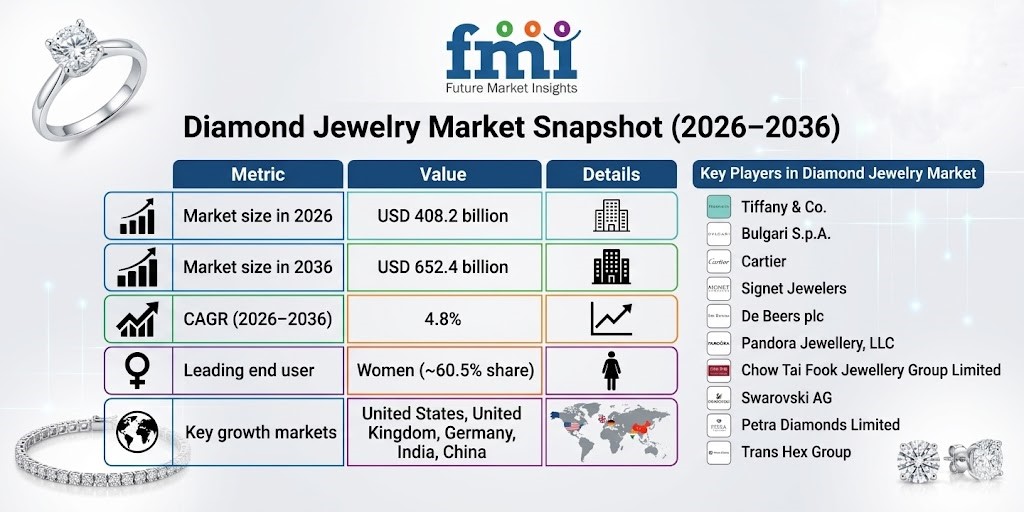
Diamond Jewelry Market Snapshot (2026–2036)
• Market size in 2026: USD 408.2 billion
• Market size in 2036: USD 652.4 billion
• CAGR (2026–2036): 4.8%
• Leading product type: Earrings (~45.0% share)
• Leading sales channel: Jewelry stores (~37.6% share)
• Leading end user: Women (~60.5% share)
• Key growth markets: United States, United Kingdom, Germany, India, China
Request For Sample Report | Customize Report |purchase Full Report – https://www.futuremarketinsights.com/reports/sample/rep-gb-16894
Market Momentum
The diamond jewelry market begins at USD 408.2 billion in 2026 and maintains a steady growth trajectory throughout the forecast period. By 2031, increased premiumization, structured retail expansion, and strong gifting demand push the market significantly beyond USD 500 billion.
Between 2031 and 2036, growth is reinforced by improved sourcing transparency, tighter inventory control, and higher-quality merchandising strategies. By 2036, the market reaches USD 652.4 billion, sustaining a CAGR of 4.8% over the decade.
Why the Market Is Growing
Growth in the diamond jewelry market is driven by evolving consumer behavior, particularly increasing self-purchase trends, gifting cycles, and demand for everyday premium jewelry. Bridal demand continues to provide a stable base, while non-bridal categories expand through lightweight and versatile designs.
Retailers are strengthening conversion rates through improved product storytelling, disciplined pricing strategies, and curated collections aligned with seasonal and event-driven buying cycles. Additionally, supply chain transparency and compliance are becoming critical factors influencing procurement decisions across global markets.
Material sourcing, documentation integrity, and consistent product quality are key differentiators, especially as regulatory and consumer expectations around responsible sourcing intensify.
Segment Spotlight
Product Type: Earrings Lead with ~45.0% Share
Earrings dominate the product mix due to high purchase frequency, lower entry price points, and strong gifting relevance. Their versatility and faster inventory turnover make them a preferred category for retailers.
Sales Channel: Jewelry Stores Retain Leadership (~37.6% Share)
Jewelry stores remain the dominant channel due to trust-driven purchasing behavior and the need for assisted selling in high-value transactions. Physical retail also ensures better price control and enhanced customer experience.
End User: Women Anchor Demand (~60.5% Share)
Women continue to lead demand across both self-purchase and gifting segments. Merchandising strategies and product development are largely aligned with women-driven demand patterns, influencing assortment planning and promotional cycles.
Regional Growth: Key Markets Drive Expansion
The United States remains a leading market supported by mature retail infrastructure and steady bridal demand. India and China emerge as high-growth regions driven by premiumization, expanding retail networks, and increasing digital adoption.
Europe, led by the United Kingdom and Germany, maintains steady growth through disciplined consumer spending and strong compliance-driven market structures.
Drivers, Opportunities, Trends, Challenges
Drivers:
• Stable bridal and gifting demand
• Expansion of branded retail networks
• Increasing premium jewelry adoption
Opportunities:
• Product premiumization and design innovation
• Growth in non-bridal and everyday jewelry segments
• Digital retail and omnichannel expansion
Trends:
• Rising self-purchase behavior
• Stronger sourcing transparency and compliance
• Structured assortment planning and inventory control
Challenges:
• Pricing pressure from discounting practices
• Supply chain complexity and sourcing compliance
• Competition from lab-grown diamond alternatives
Country Growth Outlook (CAGR 2026–2036)
• India: Expected to grow at a CAGR of 7.0%, driven by rising premiumization, expanding branded retail networks, and strong demand across occasion-based purchases.
• China: Projected to register a CAGR of 7.2%, supported by increasing digital adoption, premium product demand, and growing availability of branded jewelry collections.
• United States: Anticipated to expand at a CAGR of 5.6%, backed by mature retail infrastructure, stable bridal demand, and consistent performance in premium segments.
• Germany: Forecast to grow at a CAGR of 5.4%, supported by disciplined consumer spending, strong compliance standards, and stable demand across structured retail channels.
• United Kingdom: Expected to record a CAGR of 5.1%, driven by resilient premium consumption, organized retail presence, and controlled pricing strategies.
Competitive Landscape
The diamond jewelry market is highly competitive, with leading players focusing on brand equity, sourcing transparency, and retail execution excellence. Companies are strengthening their market position through controlled distribution, consistent pricing strategies, and curated product portfolios.
Key players are increasingly investing in digital capabilities, inventory optimization, and premium product offerings to enhance customer engagement and improve sell-through rates.
Leading companies include: Tiffany & Co., Bulgari S.p.A., Cartier, Signet Jewelers, De Beers plc, Pandora Jewellery, LLC, Chow Tai Fook Jewellery Group Limited, Swarovski AG, Petra Diamonds Limited, and Trans Hex Group.
These companies compete on design innovation, sourcing credibility, pricing discipline, and global retail expansion while maintaining strong brand positioning across premium and mid-tier segments.
Why FMI: https://www.futuremarketinsights.com/why-fmi
Explore more research reports by FMI
Warm Cap Market; https://www.futuremarketinsights.com/reports/warm-cap-market
Second-Hand Fashion Market: https://www.futuremarketinsights.com/reports/second-hand-fashion-market
Apparel Market: https://www.futuremarketinsights.com/reports/apparel-market
About Future Market Insights (FMI)
Future Market Insights, Inc. (FMI) is an ESOMAR-certified, ISO 9001:2015 market research and consulting organization, trusted by Fortune 500 clients and global enterprises. With operations in the U.S., UK, India, and Dubai, FMI provides data-backed insights and strategic intelligence across 30+ industries and 1200 markets worldwide.
Sudip Saha
Future Market Insights Inc.
+1 347-918-3531
email us here
Legal Disclaimer:
EIN Presswire provides this news content "as is" without warranty of any kind. We do not accept any responsibility or liability for the accuracy, content, images, videos, licenses, completeness, legality, or reliability of the information contained in this article. If you have any complaints or copyright issues related to this article, kindly contact the author above.
